|
3D's
BIG COMEBACK
by
Gabriel Chong & Linus Tee with John Li | 2 October 2009
Hollywood
loves a good comeback story - and there’s no bigger
comeback in the industry this year than 3D. Indeed,
DreamWorks Animation boss Jeffrey Katzenberg hails it
as the third great shift in cinema history: from silent
films to talkies, from black and white to colour and
now from 2D to 3D. Katzenberg trusts so zealously in
the future of 3D that he has announced that all future
DreamWorks Animation films are going to be made for
3D.
He has good reason for his belief. 3D movies are riding
on a wave of resurgence, if their numbers and box office
figures are anything to go by. Beginning in the 1920s,
the fad of 3D came and went twice- first in the 1950s
with movies like "House of Wax" and "13
Ghosts”" and more recently in the 1970s and
1980s with films like "Jaws 3D". Then in the
1990s and the first half the decade, 3D films almost
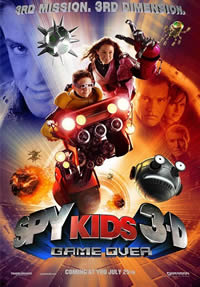
disappeared from screens (save for the occasional "Spy
Kids 3D" or "The Adventures of Sharkboy and
Lavagirl").
But the first 9 months of this year saw a total of 18
3D movies released in the United States, with close
to 10 of them playing in Singapore (some of which like
"Caroline" are still making their way to our
shores). And it seems audiences just can’t get
enough of that third dimension- recent 3D releases have
typically grossed about three to five times more at
the box office than their 2D counterparts, and that
is despite playing at fewer venues.
Bob Whitehill, Pixar’s 3D expert and driving force
behind their first 3D feature “Up”, says
that 58 per cent of "Up’s" US$290 million
in ticket sales came from 3D screenings. It’s
not just "Up"; at this year’s 3D Entertainment
Summit, Screen Digest analyst Charlotte Jones echoes
that 3D has been a main revenue driver for this year’s
summer blockbusters.
“Without 3D premium pricing, the summer would
not have registered as positive,” she says. Moreover,
she adds that where 3D has permeated a genre (like in
the animated arena), titles not available in 3D are
at a significant disadvantage. That explains why almost
all the major movie studios are planning their animated
movies in 3D- including "Toy Story 3", "Cars
2", "Happy Feet 2", "Smurfs 3D",
"Yogi Bear" and "Shrek Forever".
But it’s no coincidence that the current stereoscopic
craze is focused on the genre. 3D, which requires two
camera views- one representing the left eye and the
other representing the right- are accomplished more
easily in digitally animated worlds simply by generating
another camera view in the computer.
Live-Action 3D Is Complicated
Shooting
a live-action 3D film with camera rigs is much harder.
In order to replicate our stereoscopic view, filmmakers
shoot with two cameras placed a certain distance apart.
This interaxial distance determines the perceived depth
of the scene, also known as volume. “The wider
you separate the cameras, the more 3D volume there is,”
explains Phil McNally, global stereo effects supervisor
at DreamWorks Animation. “But if you shoot too
small, and scale up too much, viewers get a headache.”
Moreover,
filmmakers also need to calculate the zero parallax
setting, or ZPS, the point where the two digital images
converge onscreen. ZPS determines what appears to occur
in front of the plane of the screen and what seems to
happen behind the screen. A good case-in-point is Disney’s
live-action 3D feature G-Force.
In order to create the stereoscopy effects, Sony Pictures
Imageworks used a technique known as dimensionalizing-
where artists take a 2D image and pick the layers where
they want to create depth. Scott Stokdyk, visual-effects
supervisor at Imageworks, explains how big the endeavour
was: “Turning G-Force into 3D made every shot
a VFX shot and we ended up having over 1800 shots in
the movie. Spiderman 3 only had 900.”
The Digital Aid
Without digital technology, it’s
probably impossible to do a live-action 3D movie with
animated characters like G-Force. But audiences have
a lot more to thank digital technology for the revival
of 3D.
In the past, the two cameras that were required to shoot
a scene in 3D had to be aligned the correct distance
apart by hand. They also had to capture the scene in
perfect time with each other- which is quite impossible
given that the movement of film through a camera in
itself causes distortion.
Projection in theatres was also problematic as it was
not possible to perfectly align the two projectors.
The need to repair the reels of film during its screening
cycle also left discrepancies between the two reels.
All this meant that after the novelty of the extra dimension
wore off, viewers were left with a headache.
With digital technology, filmmakers now rely on computers
to determine accurately the interaxial distance and
ZPS and to align the cameras. Digital capture also eliminates
distortion, and filmmakers can digitally correct any
errors during filming in the post-production stage.
Instead of two projectors for 3D, cinemas now need only
a single digital projector outfitted with a photo-optical
device, so problems of alignment and repair were in
the days of the past.
Gone too are the red and cyan lensed glasses for audiences
to experience stereoscopy. Known as anaglyphs, they
were originally designed for black and white, so using
them on colour film led to poor colour representation
(as viewers who watched Robert Rodriguez’s Spy
Kids 3D and The Adventures of Sharkboy and Lavagirl
can attest). Today, glasses are circularly polarized
so watching a film in 3D no longer meant having to endure
the distorted colours.
Pete Buckingham, head of distribution and exhibition
at the UK Film Council puts it aptly: “The big
game change is that we now have the technology to deliver
a really good experience of 3D. It’s a combination
of digital projection and new forms of glasses that
iron out previous problems for a much more natural experience.”
The Future of 3D
Had filmmakers (and audiences) had their
way, the resurgence of 3D would probably have taken
place faster and earlier. But there’s still one
hurdle that needs to be crossed- theatres are taking
longer than necessary to replace their analogue projectors
with digital ones. In fact, director James Cameron delayed
the release of his highly anticipated stereoscopic epic
Avatar in part to give exhibitors in the United States
more time to convert to 3D capability.
The same can also be said of cinemas in Singapore. At
present, there are only 10 screens capable of playing
3D movies (that’s less than 10% of the total number
of screens here). The problem, as in the United States,
is cost. The success of recent 3D movies though shows
that it may very well be a worthy investment- especially
for the future of the cinema business.
Worldwide, the film industry has in recent years been
dealt a stiff challenge by home cinema and piracy. Amidst
this climate of declining revenues, 3D may be the film
industry’s best response to audiences- since it
cannot yet be reproduced in lounge rooms or copied by
pirates. And so far, it appears that this addition of
a third dimension- depth- to the viewing experience
has been more than successful in luring audiences back
into cinema halls.
Bob Whitehill says that the 3D experience is like going
from a filmed version of a play to watching the action
live on stage. He adds: “I spend so much of my
time watching our material in 3D that when I watch it
in 2D it's almost as though you feel the sound is turned
down or the screen isn't as big.”
"It's hard to quantify but there is definitely
something palpable and something real about seeing it
in 3D and feeling more connected to it and feeling more
a part of that world.” And this ability to bring
audiences into the film and make them feel a connection
to the story may prove to be an unstoppable force from
here on end.
“You can experience film as you actually see the
world,” Pete Buckingham says. “Think about
going from black and white to colour and even from mono
to stereo- you’re not going to turn around and
say to me that you get better sound with just one speaker.”
In the next page, we shall take a look at some of the announced 3D films that will be coming to our theatres soon >
"3D's Big Comeback" continues...
|


OTHER TITLES IN 3D:

The Adventures of Sharkboy and
Lavagirl in 3D (2005)
Chicken Little (2005)

Bolt (2008)
a
Monsters
Vs Aliens (2009)

My
Bloody Valentine 3D (2009)

Ice Age 3: Dawn of the Dinosaurs (2009)

Up (2009)

G-Force (2009)

The Final Destination (2009)

Cloudy With A Chance of Meatballs (2009)
|

