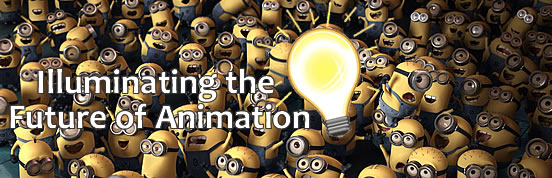
|
Illuminating
the Future of Animation
by
Gabriel Chong | 6 July 2010
Chris Meledandri may not be as familiar to you as John
Lasseter or Jeffrey Katzenberg- but the new animation
“Despicable Me” may just change that. He
is the founder and CEO of Illumination Entertainment,
the latest ‘kid on the animation block’,
whose debut feature is the family-friendly comedy that’s
opening in cinemas this week.
Unlike Disney, DreamWorks Animation
or Sony Pictures Animation, Illumination Entertainment
is an independent outfit set up outside the confines
of the studio system- though Chris’ name was enough
clout to interest Universal Pictures to co-own and distribute
all of its films (think of it like the arrangement Paramount
currently has with DreamWorks Animation). But Chris
is quick to stress the creative latitude that he retains
over all of Illumination Entertainment’s projects.
“Universal is our distribution
partner and co-owner, but Illumination is an autonomous
buyer,” said Chris in an interview with Variety
two years ago. “The structure allows me to work
in concert with Donna Langley and Jimmy Horowitz's group,
as well as Focus or Rogue when appropriate. But the
structure is that of a production company as opposed
to a corporate division.” It was precisely this
autonomy that enticed him to leave his previous position
as head of Fox’s animation group from 2000-07.
During his time at Fox, Chris
helped acquire and oversee Blue Sky Studios, the computer
animation studio behind Fox’s biggest animation
franchise, the Ice Age series, as well as “Robots”.
But it is evident from Chris’ portfolio that he
isn’t content with just making the kind of family-friendly
fare that studios typically find safe to invest in-
after all, Chris was also producer of the Wes Anderson
animation “The Fantastic Mr Fox”, as well
as animations such as “Titan AE” and “Final
Fantasy”. Flexibility is one of the main reasons
that Chris set up Illumination.
Indeed, Illumination isn’t
set up like animation studios such as Pixar. These studios
typically have much of the same in-house creative team
on board for all their films. Chris, however, is keen
for Illumination to tap on the explosion of talent in
the animation field- which explains why “Despicable
Me” is animated by a French company, not by Illumination’s
own pool of artists.
“If, as a new company,
I had decided to produce Despicable Me in Los Angeles
or in California, I would not have had the access to
the consistency of talent that I’ve had on this
film, because there are so many companies competing
for that talent. So for us, the way in which we would
get world-class talent was actually, as crazy as it
sounds, to go to Paris,” he said in a recent interview.
“France has a wonderful tradition of animation,
but they don’t even have seven major companies
competing for that talent.”
His approach of casting the creative
talent for the movie certainly shows in the character
and production design of the film. Chris brought production
designer Yarror Cheney, who worked on the popular computer
animated short film “The Chubbchubbs”, on
board “Despicable Me” and Yarror is responsible
for the cute yellow little minions featured prominently
in the ads and the trailers. On the other hand, Carter
Goodrich was responsible for the design of the human
characters and Chris is quick to point out that he offered
Carter the job after seeing Carter’s work on “Ratatouille”.
Chris is equally meticulous when
it comes to finding the right voice talent for his characters.
Despite sporting an all-star cast including Steve Carell,
Jason Segel, Russell Brand, Ken Jeong and Danny McBride,
Chris says that he starts by picking the actor whom
he thinks is likely to embody the role (and not by creating
a character around a certain actor). “If you don’t
start with that, then it sort of defies the whole purpose
of trying to make the best film that you can make.”
“But we tend to look towards,
even though our stories have dramatic components in
them we tend to look at actors who are comedic and certainly
look and listen for actors who can use their vocal tools
to create that comedy,” he added. “It is
important to us that our actors are able to help us
communicate about the film because we’re not branded.
We’re not Pixar. We don’t have any brand
and we need to excite our audience about our movie and
one of the ways that we can reach an audience is by
our actors.”
Another way that Illumination
aims to reach its audience is by tapping into the 3D
bandwagon. “There are a lot of sequences in ‘Despicable
Me’ that take advantage of the dimensional space
in a dynamic way,” said Chris. In fact, Chris
points out that all the projects Illumination is working
on are planned for 3D- and so far, that number is a
very promising three.
After “Despicable Me”,
Illumination has an Easter 2011 release date for Hop,
the story of a man (Russell Brand) who fills in for
the Easter Bunny after running him over in a car. While
Hop will be a live-action motion picture, Illumination’s
focus is still on animation. In the works are an animated
adaptation of Dr. Seuss’ The Lorax for 2012 and
a stop-motion animation version of The Addams Family
with Tim Burton on board to direct and produce.
As far as early reviews go, “Despicable
Me” may very well by this summer’s breakout
hit- which of course can only be good news for Chris
and his company. Yes, Chris Meledandri and Illumination
may not be as well-known now as John Lasseter and Pixar
or Jeffrey Katzenberg and DreamWorks, but Chris and
Illumination may very well light up the animation industry
very soon.
"Illuminating
The Future of Animation" continues...
|

A
scene from Despicable Me

Actress
Miranda Cosgrove and producer Chris Meledandri arrive
to the premiere of "Despicable Me".
(Photo by Alberto E. Rodriguez/Getty Images North America)
James
CameroTitani (1997)

Steve
Carrell (Photo by Alberto E. Rodriguez/Getty Images
North America)
Steven
Spielberg's Catch Me If You Can (2002)

Actor
Jason Segel with minions
(Photo by Alberto E. Rodriguez/Getty Images North America)
Martin
Scorsese's
Gangs Of New York (2002)
|